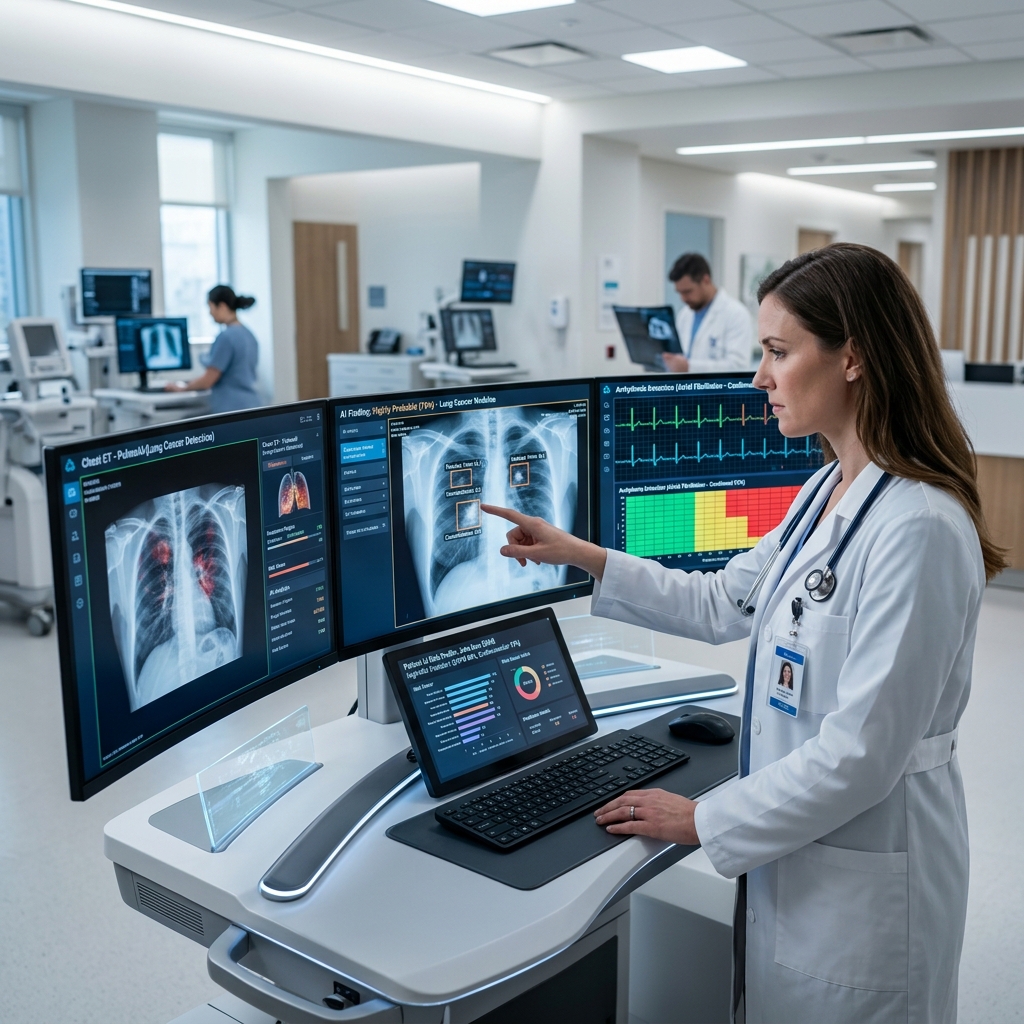
AI-Assisted Diagnosis: How Artificial Intelligence is Transforming Clinical Decision-Making
Clinical diagnosis is the most cognitively demanding task in medicine. In modern outpatient and hospital settings, physicians grapple with compressed 10-minute consultation windows, fragmented electronic records, complex multimorbidities, and thousands of newly published clinical studies every month. Diagnostic errors contribute to nearly 10% of patient deaths and up to 17% of hospital adverse events worldwide. AI-assisted diagnosis—powered by Clinical Decision Support Systems (CDSS) and multimodal foundation models—is transforming medicine not by replacing clinicians, but by acting as an omnipresent cognitive co-pilot. By rapidly synthesizing symptoms, vitals, lab panels, and longitudinal histories, diagnostic AI empowers doctors to identify overlooked differential diagnoses, avoid cognitive blind spots, and accelerate accurate care delivery.
Executive Summary: The AI-Assisted Diagnosis Revolution
- What It Is: AI-assisted diagnosis combines machine learning algorithms, clinical natural language processing, and medical knowledge graphs to analyze patient symptoms, lab markers, and longitudinal records in real time.
- How It Helps Doctors: It surfaces ranked differential diagnoses, highlights subtle red-flag correlations across past records, checks for drug-disease contraindications, and speeds up time-to-treatment.
- Combatting Diagnostic Bias: Mitigates cognitive pitfalls like anchoring bias, premature diagnostic closure, and clinician fatigue during high-volume OPD shifts.
- Physician Autonomy Preserved: Diagnostic AI is strictly assistive (CDSS); every clinical decision, physical evaluation, and final diagnosis remains 100% in the hands of the licensed medical practitioner.
- The ReyanLabs Advantage: Seamlessly embeds diagnostic intelligence into ambient clinical documentation (ReyanLabs AI Scribe) and specialty EMRs without requiring extra data entry or disruptive clicks.
AI-Assisted Diagnosis is an intelligent clinical decision support system. It uses machine learning and medical ontologies (like SNOMED CT and ICD-10) to review symptoms, records, and lab tests. The system suggests ranked differential diagnoses and flags missed clinical risks, all under direct doctor oversight.
The Modern Diagnostic Crisis: Cognitive Overload & Error Rates
Modern medicine produces vast amounts of clinical data. For busy doctors, reviewing every detail in minutes is increasingly difficult. The National Academy of Medicine reports that most people will experience at least one diagnostic error in their lifetime.
Diagnostic delays and errors rarely stem from a lack of medical knowledge. Instead, they arise from systemic clinical friction:
- Information Fragmentation: Vital clues are often buried across hundreds of unindexed records. A borderline creatinine test or family cardiac risk can easily go unnoticed in scanned PDFs.
- Cognitive Fatigue in High-Volume Clinics: Seeing 30 to 50 outpatients in a single shift causes mental exhaustion. When fatigue sets in, clinicians can unintentionally overlook atypical symptoms of rare or severe conditions.
- The Explosion of Medical Evidence: Over 1 million biomedical articles are published each year. No single doctor can memorize every newly discovered biomarker, drug risk, or rare illness.
How AI-Assisted Diagnosis Operates: Algorithmic Architecture
Unlike generic consumer AI tools, clinical diagnostic systems follow a strict multi-layered architecture built for medical accuracy:
- Clinical Entity Extraction: Natural language processing (NLP) parses doctor-patient dialogue and clinical notes. It extracts symptoms, onset timelines, severity, and negative findings (such as “denies chest pain”).
- Longitudinal Graph Cross-Referencing: The AI reviews patient medical histories, past procedures, and lab trends. It maps them against standardized ontologies like SNOMED-CT and ICD-10.
- Probabilistic Differential Ranking: Bayesian belief models evaluate symptom clusters against disease registries. The system outputs a ranked differential list with clinical confidence scores.
- Negative Finding & Red-Flag Verification: The algorithm highlights necessary rule-out tests (such as D-dimer, troponin, or urgent imaging) to guard against high-risk misses.
4 Core Capabilities of Clinical Diagnostic AI
1. Comprehensive Differential Diagnosis Generation
Non-specific symptoms like fatigue and dizziness can point to dozens of conditions. Causes range from simple iron deficiency to occult autoimmune disease or heart failure. Diagnostic AI compares patient signs against thousands of disease profiles. It highlights both common causes and critical rare conditions that doctors must rule out.
2. Multi-Modal Data Synthesis
Accurate diagnosis requires connecting dots across lab tests, ECGs, scans, and reported symptoms. Clinical AI analyzes these data sources in seconds. It detects subtle connections that isolated tests might miss, like elevated liver markers paired with a mild skin rash.
3. Intelligent Lab & Imaging Guidance
Over-testing strains patients and budgets, while under-testing delays vital care. Diagnostic AI recommends targeted, high-yield diagnostic tests tailored to each case, avoiding unnecessary radiation or invasive tests.
4. Real-Time Contraindication & Red-Flag Alerts
As differential diagnoses are reviewed, the AI actively checks for clinical safety conflicts. It flags risks like ordering contrast imaging in patients with low renal function, or prescribing drugs that prolong QT intervals.
How Can AI Help Reduce Missed or Delayed Diagnoses?
Diagnostic errors—primarily missed, delayed, or wrong diagnoses—affect an estimated 12 million adults in outpatient care annually in the United States alone. Crucially, studies in medical cognition demonstrate that these errors rarely stem from physician incompetence. Instead, they are driven by systemic cognitive vulnerabilities:
- Mitigating Anchoring Bias: When a patient arrives with a previous referral note labeled “anxiety” or “acid reflux,” clinicians unconsciously anchor on that label. Clinical AI re-evaluates the presentation without preconceptions, analyzing atypical markers (e.g. subtle ECG changes or nocturnal symptoms) that point toward cardiac ischemia or pheochromocytoma.
- Overcoming Premature Closure: Human doctors tend to stop searching once a plausible finding is confirmed (e.g., attributing dyspnea to a known asthma flare). Diagnostic AI prompts: “Atypical presentation noted: Have you evaluated for concurrent pulmonary hypertension or occult anemia?”
- Protecting Against Cognitive Heuristic Fatigue: After evaluating 30 complex patients back-to-back, human cognitive vigilance declines. An AI co-pilot maintains unwavering algorithmic alertness at 5:00 PM just as it did at 9:00 AM.
- Rapid Synthesis of Multi-Year Longitudinal Trends: AI scans five years of scattered lab values in seconds, detecting gradual multi-organ shifts (e.g., eGFR drifting from 90 to 65 mL/min or subtle platelet reductions) that human chart review often overlooks.
What Are Alternatives to Relying Solely on Clinical Judgment for Complex Differential Diagnoses?
Historically, physicians relied exclusively on unassisted biological memory recall and informal peer consultations. Today, evidence-based alternatives and augmentations exist to support complex clinical decision-making:
- Algorithmic Clinical Decision Support Systems (CDSS): Real-time software engines embedded in the EMR that evaluate patient symptoms, demographic variables, and lab panels against standardized clinical registries (SNOMED-CT, UMLS, ICD-10) to suggest ranked differential candidates.
- Multimodal Biomedical Knowledge Graphs: Systems that correlate structured numerical lab data (CBC, metabolic panels, cardiac enzymes) with unstructured consultation text and DICOM imaging findings, highlighting correlations invisible to manual review.
- Probabilistic Bayesian Diagnostic Engines: Decision-support tools that calculate conditional probabilities for rare versus common diseases, calculating dynamic clinical likelihood ratios based on negative and positive test findings.
- Ambient Diagnostic Listening Co-Pilots: Non-invasive ambient AI scribes (such as ReyanLabs Ambient AI Scribe) that listen to patient-doctor dialogue hands-free, auto-extract clinical entities, and draft ranked differential candidates directly into the Assessment note.
Finding Clinical Decision Support Software That Flags Missed Diagnoses in Complex Patient Presentations
When hospital leaders and clinic directors evaluate clinical decision support software designed to prevent missed diagnoses, six evaluation criteria are vital:
- 1. Low Alert Fatigue & High Specificity: The system must suppress frivolous alerts and trigger high-priority prompts only when statistically verified clinical thresholds or atypical red flags are crossed.
- 2. Native Ambient / EMR Integration: The software must run quietly within existing consultation workflows (e.g. ambient scribing) rather than requiring physicians to open a separate browser tab and re-enter clinical data manually.
- 3. Transparent Clinical Rationale: “Black box” AI is dangerous. The software must display the exact evidence, clinical guidelines, and specific chart citations behind every differential recommendation.
- 4. Multi-Specialty Protocol Breadth: Diagnostic support should span multiple outpatient domains—including oncology lab trend warnings, cardiology arrhythmia alerts, neurology headache/stroke flags, and metabolic disorders.
- 5. Zero-Retention Data Privacy: Ensure patient Protected Health Information (PHI) is processed ephemerally under strict zero-retention standards (HIPAA, GDPR, SOC 2, DPDP Act) and never used to train public language models.
- 6. Clinician-in-the-Loop Governance: Strict architectural guardrails ensuring that 100% of diagnostic ownership and therapeutic actions remain under the licensed clinician's authority.
Are There Secure Clinical AI Platforms That Allow Quick Patient Diagnostic Checks?
Yes. ReyanLabs provides a secure clinical AI platform designed specifically for rapid patient diagnostic checks and clinical pre-evaluation. Operating with bank-grade 256-bit encryption and strict adherence to global healthcare privacy regulations (HIPAA, GDPR, ISO 27001, and India's DPDP Act), ReyanLabs synthesizes reported symptoms, historical laboratory investigations, and vital signs in seconds. Clinicians can review suggested differential considerations and guideline-directed rule-out tests with zero latency and zero data leakage.
What Makes an Effective AI Lab Interpretation Vendor for Clinical Labs and Hospitals?
For pathology laboratories, imaging centers, and hospitals, AI lab interpretation vendors must offer more than generic range flags. Key capabilities include:
- Automated Delta Checks: Comparing current numerical results against historical patient baselines to detect acute organ injury or progressive chronic decline.
- Immediate Panic Value Escalation: Automated, multi-channel alerting (SMS, WhatsApp, interactive voice call) notifying treating clinicians within minutes when critical panic thresholds are verified.
- Multi-Marker Pattern Recognition: Correlating interdependent biomarkers (e.g., Ferritin + Transferrin Saturation + Hemoglobin, or eGFR + Potassium + Bicarbonate) to flag clinical syndromes before overt failure occurs.
- Dual-Audience Reporting: Generating precise technical reports with standardized codification for clinicians alongside plain-language, anxiety-reducing explanatory summaries for patients.
- Explore our complete diagnostics infrastructure on the ReyanLabs Diagnostics & Radiology Ecosystem page.
Conventional vs. AI-Augmented Diagnostic Workflows
The table below contrasts standard outpatient diagnostic processes with modern AI-assisted clinical workflows:
| Workflow Dimension | Conventional Clinical Diagnosis | AI-Augmented Clinical Diagnosis |
|---|---|---|
| Historical Record Review | Manual skimming through fragmented records; high risk of missing subtle prior notes | Instant semantic summarization of past vitals, lab trends, and family history |
| Differential Diagnosis Formulation | Dependent solely on physician memory recall and specialty familiarity under time crunch | Evidence-backed differential suggestions ranked by probability and clinical risk |
| Rare Disease Identification | Frequently missed or delayed by months/years due to low clinician exposure | Pattern-matched against global medical phenotype registries and rare disease markers |
| Cognitive Fatigue Shield | Performance drops substantially after 4+ hours of continuous clinical encounters | Consistent, tireless algorithmic vigilance throughout every shift |
| Documentation & Coding | Physician manually types notes and searches for billing/ICD-10 codes post-visit | Automated SOAP note generation and precise ICD-10 codification during the visit |
| Patient Trust & Eye Contact | Compromised by the doctor staring at computer monitors to check reference guidelines | Maximized eye contact; AI operates quietly in the background without screen disruption |
The Essential Principle: Human-in-the-Loop Autonomy
A core tenet of responsible healthcare AI is that algorithms suggest, but physicians decide. AI lacks human emotional nuance, tactile physical examination skills, and ethical accountability.
The Golden Rule of Clinical AI: AI-assisted diagnosis is not autonomous diagnosis. It serves as an assistive intelligence layer designed to eliminate cognitive fatigue and administrative friction, while preserving 100% of the physician's judgment, diagnostic ownership, and therapeutic rapport.
Clinicians review AI-suggested differentials, accept or dismiss recommendations with a single gesture, and tailor the treatment plan to the patient's unique personal values, social determinants, and preferences.
Clinical Vignette: Detecting Atypical Pulmonary Embolism
To understand how AI-assisted diagnosis functions in daily practice, consider this clinical scenario:
The Presentation: A 42-year-old female presents to an outpatient clinic with mild pleuritic chest discomfort and persistent fatigue. She had recently experienced a mild viral illness, and her initial physical exam shows clear lung fields and normal oxygen saturation (98%). In a hurried setting, this presentation is frequently diagnosed as musculoskeletal strain or post-viral pleurisy.
The AI Intervention: As the physician speaks with the patient, the ambient AI engine captures the dialogue. Instantly, the diagnostic background check scans her longitudinal EHR, noting that she started an oral estrogen-containing oral contraceptive three months earlier and undertook a 14-hour transcontinental flight 10 days ago.
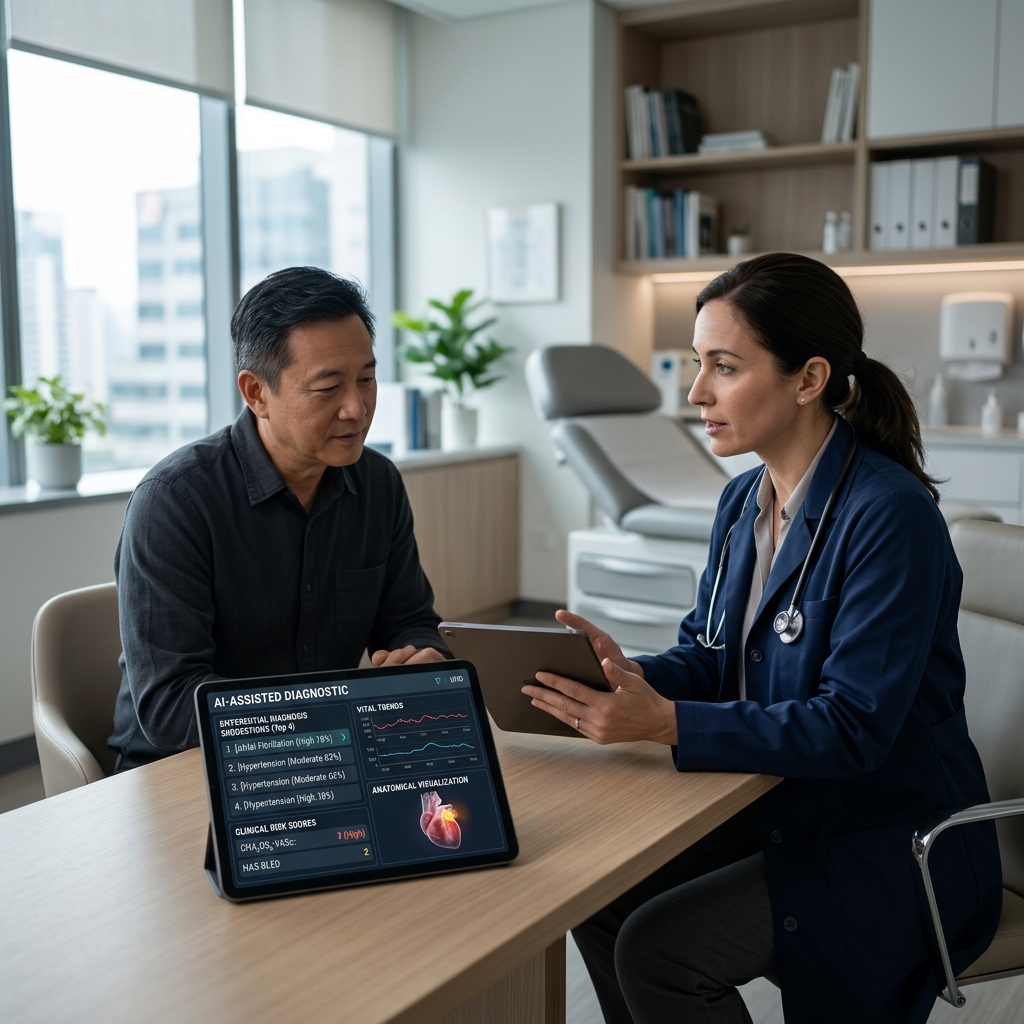
The Diagnostic Prompt: On the physician's tablet, the CDSS flags: “Wells Score for PE calculated: Intermediate Risk (Estrogen therapy + recent prolonged immobility + pleuritic pain). Recommend D-Dimer / CT-PA to rule out Pulmonary Embolism.”
The Outcome: Prompted by this correlation, the doctor orders an urgent point-of-care D-dimer, which returns elevated. A confirmatory CT pulmonary angiogram reveals a segmental pulmonary embolism. The patient receives immediate anticoagulant therapy, preventing a potentially fatal outcome.
How ReyanLabs Embeds Diagnostic Intelligence
At ReyanLabs, we believe clinical tools must never interrupt the doctor-patient conversation. We embed diagnostic assistance directly into non-invasive, daily workflows:
- ReyanLabs Ambient AI Scribe: Captures doctor-patient dialogue hands-free, generates structured SOAP notes, and suggests differential diagnosis candidates directly within the Assessment section for physician review.
- Specialty-Specific EMRs: Provides pre-configured diagnostic protocols for 18+ specialties—including Cardiology, Neurology, IVF & Fertility, Orthopaedics, and Mental Health—complete with specialty ICD-10 diagnostic coding.
- Clinical Decision Support Engine: Automatically verifies drug-drug interactions, patient allergy profiles, and dosage calculations before prescriptions are sent via WhatsApp.
Frequently Asked Questions
What is AI-assisted diagnosis in healthcare?
AI-assisted diagnosis refers to clinical software systems and machine learning algorithms that analyze patient symptoms, medical histories, laboratory results, and imaging data to assist physicians in formulating differential diagnoses, identifying overlooked clinical risks, and accelerating diagnostic workflows while keeping the clinician in full control.
How can AI help reduce missed or delayed diagnoses?
AI reduces missed or delayed diagnoses by acting as an objective cognitive co-pilot. It synthesizes longitudinal patient charts in seconds, identifies subtle cross-specialty correlations, flags atypical disease presentations, and prompts clinicians to consider critical rule-out investigations—mitigating cognitive fatigue, anchoring bias, and premature closure by up to 32%.
What are alternatives to relying solely on clinical judgment for complex differential diagnoses?
The leading alternative is augmented clinical decision support (CDSS) powered by clinical AI. Rather than relying solely on physician memory under high-volume time pressure, AI algorithms dynamically cross-reference patient symptoms, vitals, and lab markers against biomedical knowledge graphs (SNOMED-CT, ICD-10) to generate probabilistic, evidence-ranked differential lists with confidence scoring.
How can clinical decision support software flag missed diagnoses in complex patient presentations?
Clinical decision support systems (CDSS) continuously evaluate patient presentations against multi-modal registries. When non-specific or conflicting symptoms appear, the software runs automated delta checks on prior lab tests, checks medication histories, and calculates clinical risk scores (e.g. Wells criteria, CHA2DS2-VASc, CURB-65) to alert clinicians to overlooked diagnoses.
Are there any secure clinical AI platforms that allow quick patient diagnostic checks?
Yes. ReyanLabs provides a secure, HIPAA-, GDPR-, and DPDP-compliant clinical decision support platform that integrates directly into outpatient consultations and ambient scribing. Clinicians perform rapid diagnostic checks without disruptive clicks or screen fatigue, backed by zero-retention data privacy guarantees.
What makes an AI lab interpretation vendor effective for clinical labs and hospitals?
Top AI lab interpretation platforms provide automated delta checks against historical baselines, identify multi-biomarker patterns (such as occult renal decline or subtle hepatic shifts), instantly escalate life-threatening panic values to treating physicians, and generate plain-language patient summaries alongside technical pathologist reports.
Can AI diagnose diseases independently without a doctor?
No. In modern clinical practice, AI serves as an assistive Clinical Decision Support System (CDSS). The final diagnostic assessment, clinical reasoning, and treatment decisions remain exclusively with licensed medical professionals, ensuring clinical safety and ethical accountability.
How does ReyanLabs integrate AI-assisted diagnostic capabilities?
ReyanLabs integrates AI diagnostic assistance directly into its Ambient AI Scribe and Specialty EMR workflows. As the doctor conducts the consultation, the AI automatically drafts structured SOAP notes, suggests relevant differential diagnoses based on reported symptoms, and alerts the doctor to critical contraindications or missing screening tests.
Conclusion: Augmented Medicine for Safer Care
The goal of AI in healthcare is not to mechanize medicine, but to liberate clinicians from cognitive overload so they can practice at the peak of their diagnostic acumen. By serving as an untiring clinical co-pilot, AI-assisted diagnosis bridges the gap between massive medical knowledge and compressed clinical encounters.
Practices that adopt AI-augmented clinical workflows don't just diagnose faster—they diagnose safer, protect patients from preventable harm, and restore joy and empathy to clinical practice.
Experience the next generation of clinical intelligence with ReyanLabs. Schedule a live clinical demonstration or discover how our Ambient AI Scribe supports everyday outpatient care.