AI Second Opinion for Doctors and Patients: Advancing Diagnostic Precision Under Strict Clinical Governance
Clinical diagnosis is evolving rapidly. For doctors, short consultation slots and growing medical records create mental fatigue and diagnostic blind spots. For patients, complex lab reports and scans often trigger anxiety and confusion.
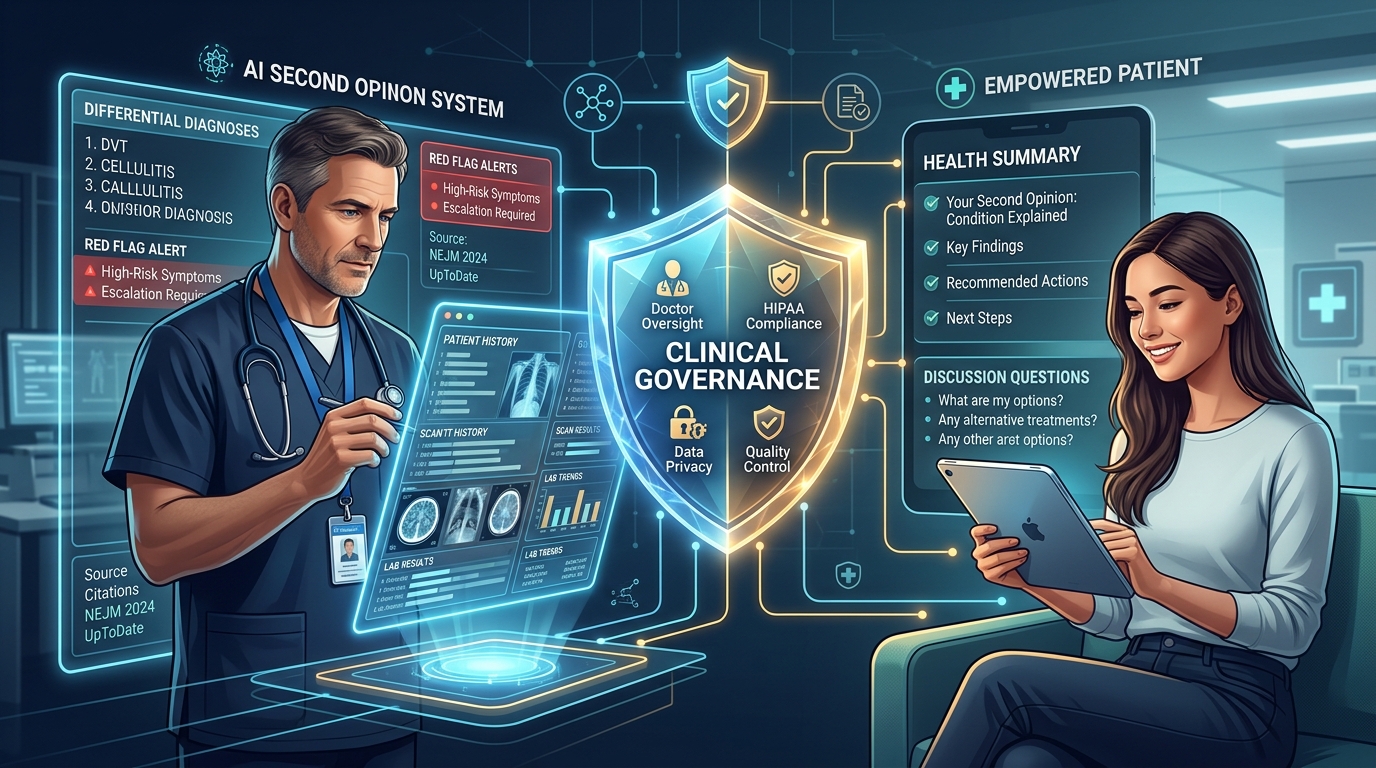
An AI second opinion platform bridges this gap. It serves two distinct roles: an evidence-based reasoning co-pilot for doctors, and a plain-language guide for patients. Both workflows operate under strict clinical governance. This keeps full diagnostic authority in the hands of the licensed physician.
Executive Summary: AI Second Opinion & Clinical Governance
- The Dual Architecture: Modern AI platforms provide separate workflows for doctors and patients. Clinicians receive differential reasoning tools in the EMR, while patients get clear explanations of complex records.
- Doctor-Facing Workspace: Integrated into the EMR, analyzing up to 90,000 characters of chart notes. It highlights documented facts, ranked hypotheses, red flags, and missing tests without saving persistent copies.
- Patient-Facing Empowerment: Translates medical jargon into everyday terms across English, Hindi, and Hinglish. Patients can understand their reports and prepare relevant questions for upcoming visits.
- Strict Clinical Governance: System guardrails refuse requests for autonomous prescribing or dosage changes. The AI never replaces clinical judgment; doctors maintain full diagnostic ownership.
- Data Privacy & Zero Retention: Complete isolation between patient portals and clinical databases. Ephemeral memory execution ensures full HIPAA, GDPR, ISO 27001, and ABHA compliance.
AI Second Opinion with Clinical Governance is an augmented intelligence framework that provides physicians with citation-grounded differential diagnoses, missing investigation alerts, and red-flag screening inside the clinical chart, while providing patients with accessible, plain-language record explanations—operating under strict medico-legal boundaries where licensed physicians retain exclusive authority over diagnoses, prescriptions, and treatment plans.
1. The Dual Dilemma: Diagnostic Overload vs. Patient Asymmetry
In high-volume clinical practice, two parallel challenges collide every day:
For Physicians: Modern outpatient schedules demand that doctors evaluate complex multimorbid patients in 10-to-15-minute consultations. A clinician must review fragmented medical histories, decipher unindexed lab trends, cross-reference polypharmacy regimens, and identify atypical presentations of uncommon conditions. In high-pressure shifts, cognitive fatigue, anchoring bias, and premature closure can cause critical nuances to slip through.
For Patients: When receiving an ambiguous diagnosis or navigating chronic disease complications, patients face acute information asymmetry. Diagnostic summaries, pathology reports, and biochemical panels are written in dense medical terminology. Without guidance, patients turn to uncurated search engines or social forums, leading to unnecessary panic, catastrophic assumptions, or unverified home remedies.
The Collaborative Bridge: An effective AI second opinion is not a replacement for medical expertise. It is an intelligent bridge that helps clinicians catch subtle blind spots and empowers patients to arrive at their consultations informed, organized, and focused on collaborative decision-making.
2. Doctor AI Second Opinion: Cognitive Co-Pilot in the EMR
Within the ReyanLabs clinical environment, the Doctor AI Second Opinion operates as an on-demand, non-intrusive cognitive workspace. Accessible through the clinical chart or initiated via ambient voice command (“Get a second opinion for this patient”), the workspace provides clinical decision support while adhering to strict boundaries:
- On-Demand Execution: The AI does not interrupt consultations or alter notes spontaneously. It generates analysis only when the doctor explicitly submits a clinical query or selects a diagnostic review angle.
- Deep Chart Ingestion: The engine ingests up to 90,000 characters of verified longitudinal records—including active conditions, allergies, current medications, past surgical notes, encounter histories, vitals, and diagnostic lab text.
- Rigorous Output Segmentation: Rather than returning generic text, the AI segments findings into distinct clinical categories:
- Documented Findings: Concrete clinical facts extracted from the record with explicit source citations.
- Ranked Differential Hypotheses: Possible diagnostic explanations evaluated against presentation phenotypes.
- Red Flags: Critical, high-risk clinical markers requiring urgent rule-out (e.g., atypical cardiovascular or thromboembolic flags).
- Treatment & Care Considerations: Evidence-based guideline suggestions for physician review.
- Missing Information: Unperformed screening tests, overdue lab panels, or diagnostic gaps necessary to confirm the diagnosis.
Crucially, this system operates with Cache-Control: no-store. Opinions are held ephemerally in component memory and are never automatically written into the permanent medical chart as legal entries.
3. Chart Evidence Grounding: Eliminating Hallucinations
The primary danger of consumer generative AI in medicine is hallucination—confidently fabricating clinical facts or citing non-existent medical literature.
ReyanLabs AI Second Opinion architecture eliminates this risk through Source-ID Citation Grounding:
- Pre-Execution Indexing: Every clinical entry in the patient's chart (e.g., an echocardiogram report, a serum creatinine level, or an allergy entry) is assigned an immutable source ID.
- Mandatory Citation Schema: Using OpenAI Structured Outputs (via enterprise
gpt-6-astraandgpt-6.1-solengines), the model is required to link every claimed clinical finding directly to one or more verified source IDs. - Automated Rejection: If the model generates a finding with a missing or unrecognized source ID, or hallucinates an external study citation, the entire response is rejected at the API gateway before reaching the doctor's screen.
- Interactive Verification: Clinicians can click “Review chart evidence” beneath any hypothesis to instantly view the highlighted excerpt from the original clinical note or lab report.
4. Patient Second Opinion: Demystifying Health Records Under Doctor Guidance
Patient empowerment must never mean unsupervised self-treatment. ReyanLabs delivers patient-facing second opinions through a dedicated, isolated platform (secondopinion.reyanlabs.com) designed specifically to prepare patients for their clinical consultations:
- Organized Record Synthesis: Patients upload lab reports, discharge summaries, and radiology imaging, or enter their known conditions and medications in everyday language.
- Multilingual Plain-Language Explanations: The AI translates clinical parameters into accessible language—explaining what an elevated HbA1c, reduced eGFR, or ambiguous ultrasound finding means in simple English, Hindi (हिन्दी), or Hinglish.
- Structured Consultation Agendas: Rather than encouraging self-diagnosis, the system produces actionable “Questions to discuss with your doctor” (e.g., “Ask Dr. Sharma if my current kidney function requires adjusting my blood pressure dosage”).
- Relieving Anxiety Without False Reassurance: The platform explains medical context objectively, calming catastrophizing tendencies while advising immediate emergency care if danger symptoms are identified.
5. The Clinical Governance Shield & Medico-Legal Safeguards
Clinical governance is the cornerstone that separates responsible medical AI from reckless automation. Both the physician workspace and the patient portal are protected by multi-tiered governance guardrails:
The Medico-Legal Principle: Artificial intelligence provides analytical assistance; licensed physicians hold exclusive legal, ethical, and clinical authority. Under no circumstances does the AI possess prescribing authority or the legal capacity to formulate an official medical diagnosis.
1. Strict Refusal of Autonomous Prescriptions
If a patient or user prompts the AI to write a prescription (e.g., “Can you prescribe me Amoxicillin 500mg?”) or alter a medication dosage (e.g., “Should I take two heart tablets instead of one?”), the system triggers an immediate, hard refusal:
“I am an AI assistant and cannot prescribe medications or alter prescribed dosages. Modifying your medication without physician guidance carries severe clinical risks. Please consult your attending doctor immediately or click here to book an urgent clinical evaluation.”
2. Strict Role-Based Access Control (RBAC)
The doctor-facing second opinion workspace is not accessible to general clinic staff. Administrative users, front-desk receptionists, and billing coordinators are strictly denied access by backend permission policies (IsDoctorInOrganization). Only verified medical doctors linked to the active clinic profile can initiate chart reviews.
3. Architectural Isolation
The patient second opinion portal (secondopinion.reyanlabs.com) is architecturally segregated from the hospital clinical portal (care.reyanlabs.com). Clinic records are not automatically dumped into public AI prompts; patients explicitly select which personal records they wish to review and provide consent for each session.
6. Comparative Architecture: Doctor Co-Pilot vs. Patient Portal
The table below illustrates how ReyanLabs tailors the second opinion workflow to doctors and patients while preserving overarching clinical governance:
| Workflow Dimension | Doctor AI Second Opinion (In-EMR) | Patient Second Opinion (Portal) |
|---|---|---|
| Primary User | Licensed Physicians & Subspecialists | Patients, Family Members, Caregivers |
| Interface & Access | EMR Clinical Workspace / Voice Command | Dedicated Web Portal (secondopinion.reyanlabs.com) |
| Input Data Scope | Complete longitudinal chart (labs, notes, vitals, meds) | Patient-uploaded reports & self-reported symptoms |
| Terminology Level | Formal medical nomenclature (SNOMED, ICD-10, pharmacodynamics) | Plain conversational language (English, Hindi, Hinglish) |
| Key Outputs | Ranked differentials, red flags, missing lab checks | Record explanations, health context, doctor questions |
| Evidence Grounding | Direct citations to verified chart excerpts | Direct correlation to patient-uploaded documents |
| Prescription Authority | Zero (Physician drafts orders via standard EMR) | Strict refusal (Never writes or modifies prescriptions) |
| Clinical Governance | Physician-in-the-loop validation of all suggestions | Mandatory disclaimer; preparation for clinical visit |
7. Clinical Vignette: Polypharmacy & Atypical Presentation
To see this governed dual-architecture in action, consider the case of a 61-year-old patient named Ramesh:
Ramesh had been managing type 2 diabetes and hypertension for 8 years. Over three months, he developed progressive muscle aches, subtle peripheral edema, and mild cognitive fog. A routine panel showed a modest rise in serum creatinine (from 1.1 to 1.6 mg/dL) and borderline elevated creatine kinase (CK). Ramesh was anxious, fearing rapid renal failure.
The Patient Experience: Before seeing his physician, Ramesh uploaded his recent metabolic panel and medicine list to the ReyanLabs Second Opinion portal. The system explained in Hindi that his kidneys were filtering slightly slower than before, but clarified that this was not acute end-stage failure. It highlighted that his recent addition of a statin paired with an existing fibrate might be contributing to muscle aches and creatinine shifts. Crucially, it generated three clear questions for Ramesh to ask his doctor.
The Physician Experience: During the consultation, Dr. Verma opened Ramesh's chart in the ReyanLabs EMR and clicked AI Second Opinion. The system analyzed Ramesh's full 4-year history across 18 visits and flagged an overlooked drug-drug interaction between his newly started Atorvastatin dose and long-standing Gemfibrozil, citing both pharmacy dispatch notes. It categorized the presentation as early statin-induced myopathy with secondary mild acute kidney injury, highlighted an elevated CK trend, and suggested checking spot urine protein while discontinuing the interacting agent.
The Governed Outcome: With Ramesh arriving organized and calm, and Dr. Verma equipped with an instant, citation-backed cross-reference, the consultation took just 11 minutes. Dr. Verma adjusted the lipid medication, scheduled a 2-week renal follow-up, and Ramesh avoided an unnecessary emergency hospital admission.
8. Frequently Asked Questions
No. Legally and clinically, an artificial intelligence system cannot issue an official medical diagnosis, sign an order, or provide a legally binding second opinion. It functions strictly as an assistive intelligence tool—helping clinicians catch diagnostic blind spots and helping patients prepare informed questions for their licensed healthcare provider.
ReyanLabs enforces enterprise healthcare compliance across HIPAA, GDPR, ISO 27001, SOC 2 Type II, and India's ABDM/ABHA frameworks. Data transmissions are encrypted end-to-end with AES-256. Second opinion queries execute with zero data retention, meaning patient medical data is never saved in persistent AI cache or used to train public foundation models.
The system executes an immediate, non-negotiable refusal. It explains that AI cannot prescribe medications, warns against self-medication, and provides an instant one-click link to schedule a consultation with an authorized clinician.
9. Conclusion: Governed Collaboration for Safer Care
The future of clinical medicine does not belong to autonomous algorithms operating in isolation, nor does it belong to overburdened clinicians struggling against impossible administrative loads.
By providing doctors with evidence-backed differential reasoning and empowering patients with clear, accessible medical understanding—all within the safe bounds of clinical governance—AI second opinions elevate diagnostic precision, rebuild patient-physician trust, and deliver safer, more compassionate care.
Explore how ReyanLabs brings AI second opinions, ambient clinical scribing, and patient engagement software & clinic CRM into a unified, compliant clinical operating platform. Schedule a consultation with our clinical solutions team today.